2013/10/25

Purposes of Assessment for learning and teaching?


Before I start to write down my learning on the topic of assessment & evaluation during the VOC1 session, I recalled my own past experiences in being evaluated as a student since elementary school to university and evaluating the studies of my own students since I became a teacher.

The means of evaluation in my study history were mainly grades based on exams, sometimes one big exam for the whole academic year, sometimes a few or many periodical exams for a final grade etc. This was particularly the case in my elementary school, middle school and high school. Studying at University of Oulu, I was an excellent student with always grades 4, or 5. Well, the grades were based on partly exams, partly different kinds of task, e.g. term paper for a research topic, presentation for a group work, either individual or group work etc. However, exam was still the dominant element in the whole assessment process. I grew up with exams, so I did feel it was natural for students to be evaluated with the results of their exams, thus I had been using this way to evaluate my students since I was becoming a teacher. Particularly, for my accounting class, I thought exam should be the best method which I could use for evaluation. It would test the principle understanding of the students, avoiding free rider problem in group work and was fair to everyone.

The iVET programme did open a window for me, showing a broader picture about the assessment and evaluation of both learning and teaching, prompting me to think about the questions from different perspectives.

What are the purposes of assessment? As a teacher, is our goal of assessment to motivate the students to learn? In which ways our students will learn based on their understanding of assessment? Will the backwash problem happen? Will the methods of assessment be beneficial for learning? Räisänen and Frist (1996) divide the purposes of assessment into guidance of learning, controlling, selection, prediction, motivation and development. For example, the control purpose of assessment is the external control in connection with a behaviouristic perspective on the assessment of learning, and quantitative criteria are often used through tests; for the motivating purpose of assessment, the central role of the assessment is to motivate creating activity and direct the actions of students; for the purpose of development, feedback method plays an important part in the assessment, through which the student are able to learn about their mistakes or shortcomings, understand how to make progress to continue development in their learning; the selective and predictive purposes of assessment are assembling students’ knowledge through planned assessment, learning progress can be predicted based on the assessment; the guiding purpose of assessment is to influence and guide the students how to study based on their experiences and assumptions of the assessment, thus methods used are linked to how they would direct studying. The various purposes of assessment can be achieved through different assessment methods. The purpose of the assessment is to support students’ effort to reach the desired, expected outcome, and at same time find out the level of achievement.

In the coming blog, I will discuss about the specific methods used for the assessment of learning and teaching.


References:
Räisänen, A. & Frisk, T.1996. The context of student assessment. Silta uuteen opiskelija-arviointiin. Helsinki, Opetushallitus arviointi 6/1999.

Hyppönen Olli & Linden Satu 2009, Handbook for teachers - Course structures, Teaching methods and assessment, Helsinki University of Technology


2013/10/23

The principles of different theories in our leaning and teaching


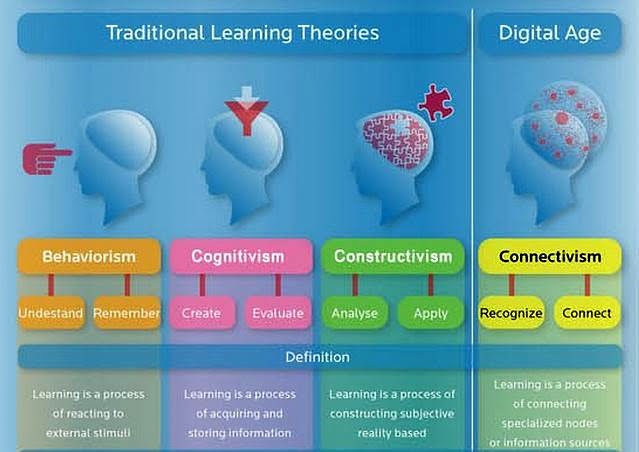
What is learning? Learning is response, strengthening, knowledge acquisition and knowledge construction. Learning is a relatively permanent change in behaviour and knowledge (Woolfork).

Behavioural Approaches to Learning are emphasising on experimental procedures to study behaviour in relation to the environment.
Classical conditioning model: responses can be predicted by given stimulus.
Stimulus-response model:                  Natural stimulus → meaningful stimulus → response

The key element is association. So the teachers may associate variety positive event in classroom and activities. 

Operant conditioning:
Leaning occurs through rewards and punishment, in which an association is made between a behaviour and a consequence for that behaviour. Example: a child completes his homework (behaviour), so he gets a reward from his parents (consequence), so he will continue to do so (further behaviour). This is a positive outcome, in the contrary, a punishment would reduce the behaviour, e.g. if not completing his homework, he would get a punishment (Thorndike’s Law of Effect).
In education, applying operant conditioning is to purposely change human behaviour. It increase desirable behaviour while decreasing undesirable behaviour. Specify the behaviour to be changed; Plan a scientific intervention; Truck the results and modify the plan if necessary. 

The main critic to the behaviourism is that it only identify only a fragment of human capabilities.

Cognitive approaches to learn
Cognitivists look at the individual’s mental processes. They are concerned with cognition – the act or process of knowing, e.g. Piaget explored changes in internal cognitive structure and identified four stages of mental growth; Brunet explored how mental process could be linked to teaching, i.e. learning through discovery.
The principles of the cognitive approaches: Instructions should be well-organised and clearly structured. The emphasis should be getting students to monitor, manage, and regulate their own behaviours.

Bandura’s Social cognitive learning includes social and cognitive factors as well as behaviour. 
Three elements:
  1. Environmental factors: 
  2. Situation factors:
  3. Bahavioural capabilities:


A self regulatory learning approach is based on the social cognitive learning theory as following:


References:
Infed, Learning theory: Models and Product, Process
<http://infed.org/mobi/learning-theory-models-product-and-process/>

Baran Evrim, Slideshare, Behavioral approach to learning
<http://www.slideshare.net/evrimb/week-8-behavioral-approach-to-learning>

Parmer Sondra, Behavioral approach to learning and teaching, Auburn Univerisy, fall, 2003
<http://www.ag.auburn.edu/>


2013/10/22

Timeline of Learning theories


I made a table to help myself figure our the history and research development of learning.

Year


1989
Palvo
Behaviorism
Classical conditioning, a learning process that occurs through associations between an environmental stimulus and naturally occurring stimulus.
1913
Skinner
Behaviorism
Operant conditioning, a method of learning that occurs through rewards and punishments for behavior.
1950
Erikson
Stage model
Theory of personality
Childhood and society, personality develops in a series of stage, impact of social experience across the whole lifespan.
1961
Maslow
Humanism
Hierarchy of needs, people are motivated to fulfill basic needs before moving on to more advanced needs.
1961
Piaget
Cognitivism
Children progress through four key stages of cognitive development, theory of intellectual development (4 distinct stages: sensorimotor stage; preoperational stage; concrete operational stage; formal operational stage).
1966
Burner
Constructivist theory - discovery learning
Learning is an active process in which learners construct new ideas or concepts based on their current/past knowledge, the theory is based on study of cognition.
1967
Piaget
Constructivism - Social theory
People produce their knowledge and form meaning based upon their experiences, teachers are facilitators.
1977
Bandura
Social learning theory
Added a social element, people can learn new information and behaviors by watching other people.
1984
Kolb
Learning style theory
Four stages in which learners touch all: Concrete experience, Reflective observation, Abstract conceptualization, Active experimentation, effective learning is seen when a person processes through a cycle of 4.
1984
Garner
Theory of Multiple intelligences
All people have different kinds of intelligences (he proposed 8),  a person may have more than 1 capabilities and talents needed to be capture.
1994
Vygotsky
Constructivism – social culture theory
Social interaction leads to continuous step-by-step changes in children’s thoughts and behaviors that can vary from culture to culture, development depends on interaction with people and the tools culture provides,  combines social environment and cognition.
2004
George Siemens
Connectivism – a learning theory for digital age
Emphasis the role of new technology on the impact of learning of people, the changes to way of how we learned before.


References:

Timeline beta, Leaning-theory-timeline,

About.com, Psychology

Instructional Design, Constructivist theory,


George Siemens, Elearnspeace, Connectivism: A learning Theory for the Digital Age, 12.12.2004

2013/10/21

My first teaching video was fun!!!


Making video is not new for me, though I am not a professional, but making a video of my teaching was the first time. I felt that was not as easy as I thought, though it was just 5 minutes. I realized that I needed to speak the words correctly, without making major mistakes & long pause, voice had to be proper. Also how I posed, stood, and dressed needed to be proper (of course, there is no standard, but we all have common knowledge for it). But when I watched my video, I loved it and sent it to my mum and other relatives in China. It was fun, and I would like to do it in the future for different purposes.


Role of learning styles and strategies in study guidance/tutoring/teaching


Each person may have different learning styles, or may have a mix of learning styles with a dominant style all time, or with the use of different styles in different circumstances. Learning styles may also keep developing in your lifetime.

There are many theories related to people’s learning styles, development of learning and how people learn. According to the theory of Multiple Intelligence by Howard Garden, people’s learning styles can be categories into the following 7:
  1. Visual:             people prefer to use pictures, images, diagrams, colours and mind maps. For this type of learners, we could use colours, layout, charts, filmstrips, notes and flash cards, “visual words”, map, system diagrams, replacing words with pictures, and using colours to highlight key points.
  2. Physical (kinaesthetic):           people prefer “learning by doing”, e.g. drawing diagrams, using physical objects, role playing, body and sense of touch to learn, they like to think out issues, ideas and problems while exercising etc. For this type of learners, we could use teaching methods related to touch, action, movement and hands-on work and let them exercise writing and drawing the things learned, using role play etc.
  3. Aural:              people prefer using sound, rhythms, music, recording etc.  For this type of learners, we could use sound, rhythms, and music in teaching to focus on using aural content in their association and visualization.
  4. Verbal:            people prefer using words in both of speech and writing. They love reading and writing. For this type of learners, we could use role playing for them to learn, drama, scripting to let them write down. Make the most of word-based techniques methods for the students.
  5. Logical:           people prefer using logic, mathematical reasoning to explain or understand concepts, they want to understand the reasons and have the ability to understand the bigger picture. They easily recognize patterns, classify and group information to learn. For the type of learners, we could use methods of math games, logic puzzles, experiments, codes, analogies, numbers etc.
  6. Social (interpersonal):             people prefer learning in groups. They communicate well with perople, both verbally and non-verbally. For this type of learners, we could use group study and work, role-playing, methods for them to speak, share, and get feedback, board games, collective problem solving, interviewing, peer tutoring, discussion etc.
  7. Solitary (intrapersonal):           people prefer to learn alone and self-study. They can concentrate well, focusing their thoughts and feelings on the topic. For this type of learners, we could use methods of scrapbooks, reflection, goal-setting, self-directed projects, debates, memoir etc.
In reality, we always need to make a combination of multiple methods to help to solidify the learning. 


References:
Ferriman Justin, LearnDash, 7 learning styles – which one are you?

Learning-style-online.com, New to learning styles?

Learning styles and teaching


2013/10/20

How to overcome initial nervousness?


For most of people, it is very natural to be nervous when doing things for the first time, or even longer time. For me, even I have been a teacher for almost 5 years, but I could still feel nervous when something new to me. My experience is
  • To make a good preparation for the teaching, what is first, second… so you wouldn’t easily forget steps, thus may reduce your nervousness.
  • Practice a few times before start, thus you would kind of being familiar with the words to say and time control on the process. 
  • Slow down yourself, thus you would remember what you are going to do.
  • Whatever your topic would be, make a thorough research and understanding on it. Otherwise, with little knowledge, you would feel insecure and show the sign of nerve, especially if you also need to answer questions about your topic from audiences. The more you know your topic and the more confident you feel.
  • Move around a bit if you can.
  • Small jokes or casual conversation to start.
You will be alright after a while, but certainly the above tips would help you overcome the nervousness to some extent. 

Online teaching VS. Classroom teaching


There are different types of online teachings depending on the techniques used. When teaching Economics to IB students sitting in Sotkamo Lukio while I was in Oulu, we were using e-Beam. We looked at each other through TV, my teaching delivered through computer displaying on the whiteboard in their classroom, kind of like a long distance classroom, we talked and discussed freely without any microphones on our heads. I was able to monitor each one within the territory of the camera. I had tools to present my materials either using PPTs through computer, or document camera. When studying iVET programme, I got to know the ‘adobe’ online learning. Comparison of the two, there are both advantages and disadvantages with each one. For the eBeam online teaching, you have more tools to use for teaching, looking at each other better, thus easier to interact with the students compared with adobe, however, adobe is much more convenient for students without location control. Anyone who is allowed to join, with internet and computer, is able to come in to study, to share and discuss.

Compared with classroom teaching, the advantages of online teaching lie on:     

  1. Location flexibility. This is a huge advantage and an important contributor to the success and growth of online teaching. Particularly the advancement of technology has improved the quality of communications and suitable teaching methods and tools have been introduced and used by the teachers, so people, for example from Helsinki, are willing and able to study from teachers sitting in Oulu without physical appearances.
  2. Cost effective. Obviously, the online teaching and learning are beneficial to both individual personnel and country as a whole, e.g. people living in rural areas far away from cities are able to study; people living in different places are able to study the desired subjects without much cost etc.
  3. You can have detailed notes on your table or close to you when you are teaching, and this is good when you are a new teacher or new to the topic, or you might worry about forgetting something important etc.

The disadvantages of online teaching are:

  1. More difficult to interact with the students, you can’t easily see the others’ emotional reactions, or judge their understandings, or simply walk around the classroom to get to know each student.
  2. For some subjects, you definitely have to prepare for the teaching differently. For example, in my accounting course in the classroom, if I want to demonstrate the case or any particular live questions with mathematic calculations, I just use a pen writing down on the white board, add or delete purposed steps easily, but for online teaching, it is hard to do it as easy as in the classroom, and I might not easily know which particular step is needed for more focus. I have to carefully design the course with the available tools or any other tools which I can use for this type of study.
  3. When the computer collapses, teaching is over, wait for fixing it or do it next time! We all might have experienced it, no matter how advance the technology will be, still it is made by human.
As a modern teacher, we need to be ready for all types of teaching and able to teach effectively as well.

What kind of language (grammar, vocabulary) should I use when teaching?


For this topic, I would say it really depends on the teacher’s English skill. If your English skill is somehow limited, then you might need to more focus on how to deliver your teaching clearly and understandably, rather than sticking to the issues of grammar or vocabulary. At this point, clarity and understanding need to be done at least. On the other hand, if your students are with limited English skills, then this is also the idea that can be applied.

For some subjects, accurate English is required, particularly the vocabulary used. However, you can try to teach the knowledge in other words which are familiar to everyone, later you end up with the exact words required by the subject. As a teacher, I do believe, that the better English skill you have, plus your good teaching skill, the more effective the teaching should be, and also is able to keep the teaching consistent and interesting. 

2013/10/19

“Teaching in English: a chore or a bonus? My experiences using English in teaching”


Teaching in English for me at the beginning was not optional, but compulsory, as I am not a Finn, with limited Finnish skill, but living in Finland, also because my mother tongue is not a world language, so if Finnish skill was not enough, it left me no choice but to go with English. However after more than three years of teaching at a high school and university of applied sciences in Oulu, I can honestly say now that it has been the best decision I have ever made.

The nerves and stress in the beginning
I did not plan to be a teacher after I moved to Finland, as I had always been working in the business area. I had been trying to be a financial analyst, but language barrier made my dream difficult to come true. Then suddenly, I was asked whether I was interested in teaching accounting in English. I was kind of fear and trepidation. Though the subject was easy to me, I was quite uncertain with my English capability to carry on one to two hours lecture each time in a very professional way. I practiced at home again and again, to make sure on my pronunciation clearness, sufficiency of vocabulary, controlling time used etc. Good preparation has been always important, but it couldn’t take away your nerves and stress in the beginning, so I was still extremely nervous and stressful, particularly I worried about the possible prejudice as I am neither a Finn nor a native English speaker. Well, the first lesson finally came, having put in much practice, the lesson went quite well, I showed no signs of my nerves as I was teaching, though I really was. The nerves and stress have been finally overcome through more and more experiences, increased confidence in both of teaching and English skills.

Diversity in English accent and skill
Teaching at different schools, i.e. Oulu Lyseon Lukio IB section, University of Applied Sciences and Oulu vocational school, I have been facing challenges from another side – my students, as each school has different types of students. I was teaching highly educated IB students that practically speak better English than I do, and teaching students at vocational school, whose English was really limited. Then the ways how you teach, the use of vocabulary and terminology, the classroom activities have to be different in order to fit their different English capabilities. I have gained this experience and knowledge through friendly feedbacks and angrily complaints from students in different school.

Half of my students (except vocational school) were not Finns, particularly students at OAMK were from many countries across the world. They came to Finland to study, either as formal students (attending the full degree programme), or as exchange students (from a few months to a whole academic year). Can you imagine, they spoke English with different accents? It was so hard for me to clearly understand the questions from Indian & Pakistani students, African students, or sometimes individual student with different accent. It was so embarrassed to ask the students to repeat their questions again and again, and sometimes I was not sure whether I had answered the right questions etc. So the challenge was not only my capability to use English in teaching, but also I had to work on improving my capability to understand the different accents, and this was not optional, but compulsory. As a professional teacher teaching to international students, you have to know there are British English, American English, South African English, Indian English, African English, Australian English etc., and no standard pronunciation in spoken English, there is much diversity in the English world.

Personal growth
Through teaching in English, I was given the opportunity to redefine myself. The stresses and successes of teaching in English help redefine who I am. I personally have used this time to study English more than ever, read a lot of books and become more spiritual. Compared with before, my English has been improved significantly from all aspects, i.e. reading, speaking, understanding and writing. There is much more than just the improvement in English, the confidence you have gained, the different cultures from the international students you have learned, the awareness you have to see things from different angles etc. all these are going to be your great assets in your personal growth.

For me, this has been the best decision I have ever made! I feel it is absolute a bonus to experience all these. 


2013/10/14

What is learning through discussion?

In my opinion, it is similar with so called ‘constructive teaching‘, which is based on the ‘constructivist learning theory’.

1)The key point is that learning occurs as learners are actively involved in a process of meaning and knowledge construction as opposed to passively receiving information.

2)Learners are the makers of meaning and knowledge.

3)Constructivist teaching fosters critical thinking, and creates motivated and independent learners.

4)The teacher avoids most direct instruction and attempts to lead the student through questions and activities to discover, discuss, appreciate, and verbalize the new knowledge.

5)The characteristics of the classroom would be:
  • the learners are actively involved
  • the environment is democratic, where the teacher facilitates a process of learning in which students are encouraged to be responsible and independent
  • activities are interactive and student - centred
  • the teacher's role is to facilitate and guide discussion by asking questions in the purposes of leading them to develop their own conclusions on the subject.

On the other hand, learning through discussion (online discussion) can be understood that a learning model acknowledges the advances of technology in society where learning is no longer an internal, individualistic activity (Connectivism theory background). 


  • How people work and function is altered when new tools are utilized; 
  • The learning could be achieved through online discussions, sharing ideals, knowledge through social connection and networks etc.


Then, there is a strong view of 'New Methphors of Learning: Going Beyond Constructivism' (given by Juha, optimal website), talking about how learning can be achieved with a suggested model (PI – model). This new model criticizes and extends the Constructivism. The question might be how we could use an interesting method to teach this model? 


References: