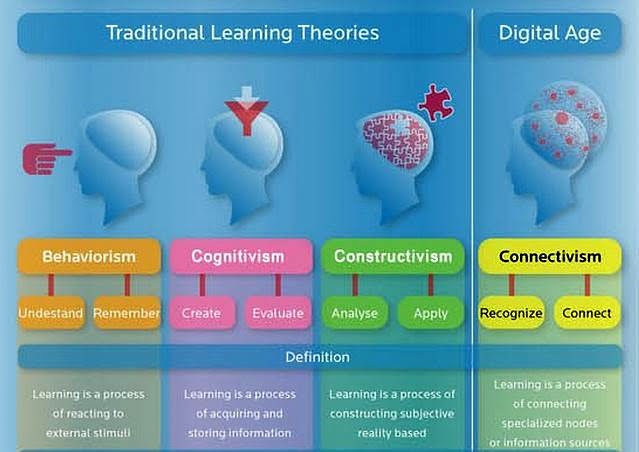
I made a table to help myself figure our the history and research development of learning.
Year
|
|||
1989
|
Palvo
|
Behaviorism
|
Classical conditioning, a learning process that occurs through
associations between an environmental stimulus and naturally occurring stimulus.
|
1913
|
Skinner
|
Behaviorism
|
Operant conditioning, a method of learning that occurs through rewards
and punishments for behavior.
|
1950
|
Erikson
|
Stage model
Theory of personality
|
Childhood and society, personality develops in a series of stage,
impact of social experience across the whole lifespan.
|
1961
|
Maslow
|
Humanism
|
Hierarchy of needs, people are motivated to fulfill basic needs before
moving on to more advanced needs.
|
1961
|
Piaget
|
Cognitivism
|
Children progress through four key stages of cognitive development, theory
of intellectual development (4 distinct stages: sensorimotor stage; preoperational
stage; concrete operational stage; formal operational stage).
|
1966
|
Burner
|
Constructivist theory - discovery learning
|
Learning is an active process in which learners construct new ideas or
concepts based on their current/past knowledge, the theory is based on study
of cognition.
|
1967
|
Piaget
|
Constructivism - Social theory
|
People produce their knowledge and form meaning based upon their
experiences, teachers are facilitators.
|
1977
|
Bandura
|
Social learning theory
|
Added a social element, people can learn new information and behaviors
by watching other people.
|
1984
|
Kolb
|
Learning style theory
|
Four stages in which learners touch all: Concrete experience,
Reflective observation, Abstract conceptualization, Active experimentation, effective
learning is seen when a person processes through a cycle of 4.
|
1984
|
Garner
|
Theory of Multiple intelligences
|
All people have different kinds of intelligences (he proposed 8), a person may have more than 1 capabilities
and talents needed to be capture.
|
1994
|
Vygotsky
|
Constructivism – social culture theory
|
Social interaction leads to continuous step-by-step changes in
children’s thoughts and behaviors that can vary from culture to culture,
development depends on interaction with people and the tools culture
provides, combines social environment
and cognition.
|
2004
|
George Siemens
|
Connectivism – a learning theory for digital age
|
Emphasis the role of new technology on the impact of learning of
people, the changes to way of how we learned before.
|
References:
Timeline beta,
Leaning-theory-timeline,
About.com,
Psychology
Instructional Design, Constructivist theory,
George Siemens, Elearnspeace, Connectivism: A
learning Theory for the Digital Age, 12.12.2004


No comments:
Post a Comment